44 Downloads Updated 4 days ago
Strong Reasoning at Constant Memory. EdgeRock-4B by Rock Matrix, powered by learned memory anchors. Requires the EdgeRock Ollama runtime.
ollama run rockmatrix-ai/edgerock:4b-q8_0
Details
Updated 4 days ago
4 days ago
794e1751df4a · 4.9GB
Readme
EdgeRock
Strong Reasoning at Constant Memory
ROCK MATRIX · Website · GitHub · Technical Report · Hugging Face
EdgeRock brings strong reasoning to a fixed history budget. Long reasoning trajectories, extended conversations and agent workflows all place increasing pressure on inference memory. EdgeRock keeps persistent history constant in sequence length, creating more room for reasoning and concurrent requests on the same hardware.
EdgeRock-4B is the first open-source model in the family. It combines recurrent state, sliding-window attention and Rock Memory Anchors (RMA): learned records that keep selected distant information directly retrievable during generation.
This Ollama release provides seven GGUF text-model quantizations, from 2.44 GB to 4.89 GB, for EdgeRock’s RMA-enabled Ollama. The default Q4_K_M package contains approximately 2.94 GB of weights.
Reasoning, memory, and scale
Research results below describe the original EdgeRock-4B model and its reported CUDA inference implementation.
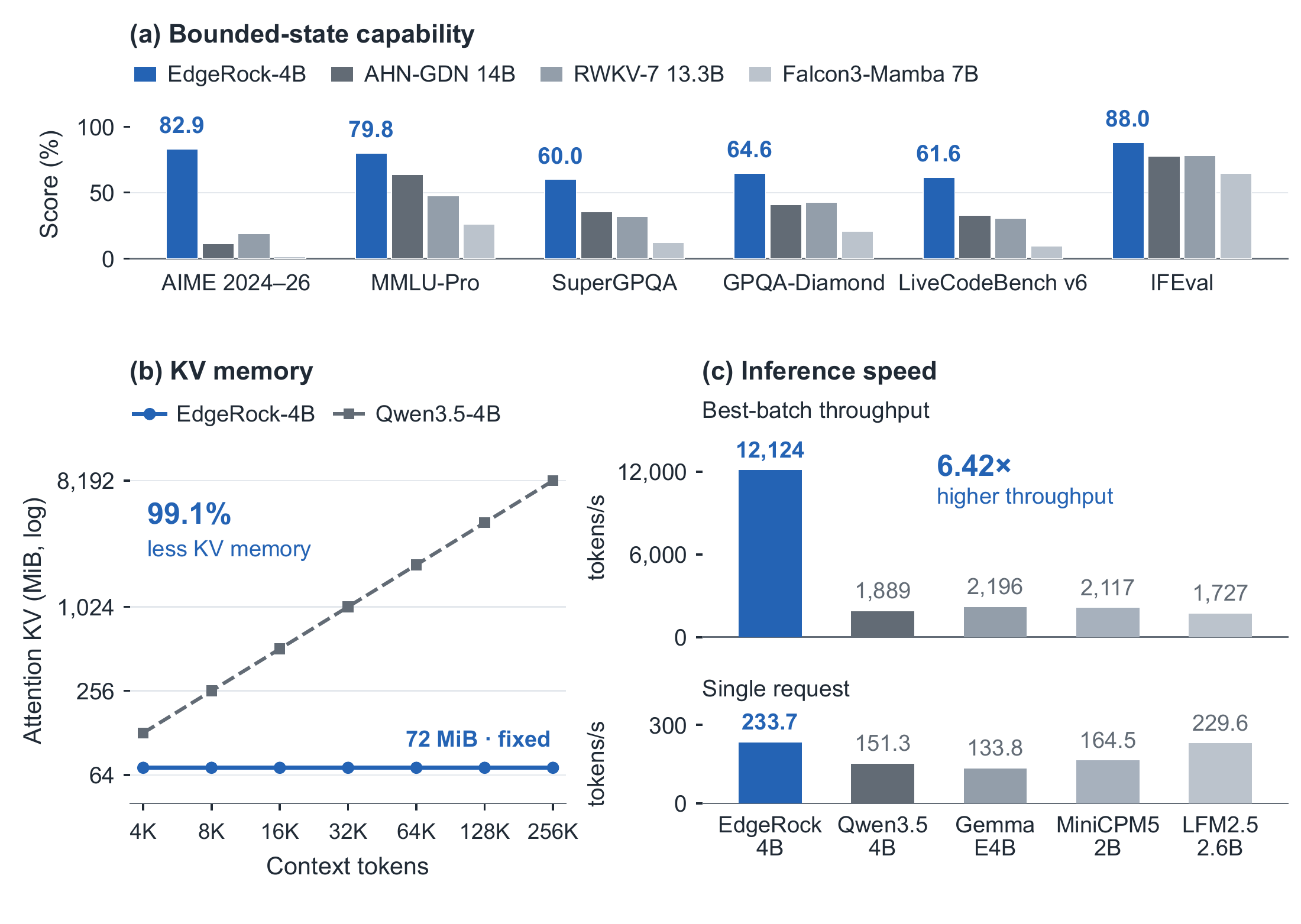
Strong mathematical reasoning. EdgeRock-4B reaches 82.9% mean AIME pass@1 across 2024–2026, compared with 18.8% for the strongest evaluated bounded-state baseline in the 14B class. It also achieves 97.5% on MATH-500. These results demonstrate that strong mathematical reasoning can operate within a constant history budget.
O(1) history memory. Attention-KV capacity remains fixed at 72 MiB per sequence in the reported BF16 configuration. At 256K context, this is 99.1% less attention-KV storage than Qwen3.5-4B’s 8 GiB. Selected distant information remains available through the anchor bank after leaving the local window.
Higher serving throughput. On one Hopper 80GB GPU, EdgeRock-4B delivers 6.42× Qwen3.5-4B’s output throughput: 12,124 versus 1,889 output tokens/s, at each model’s best measured batch. The workload uses 32K input and 32K output; throughput counts output tokens and includes prefill time. At 128K input and 128K output, single-request decoding reaches 233.7 tokens/s, excluding prefill.
Strong reasoning within the bounded-state class
| Model | AIME 2024–2026 | MATH-500 | MMLU-Pro |
|---|---|---|---|
| EdgeRock-4B | 82.9 | 97.5 | 79.8 |
| AHN-GDN Qwen2.5 14B | 11.4 | 80.0 | 63.5 |
| RWKV-7 G1j · 14B class | 18.8 | 77.2 | 47.6 |
| Falcon3-Mamba 7B Instruct | 1.2 | 41.8 | 26.1 |
Scores are percentages; AIME is the three-year mean pass@1. The complete comparison covers 16 bounded-state baselines.
Memory that reasoning can use
RMA gives EdgeRock a fixed-capacity memory of individually retrievable key–value records. A record can remain readable long after its source information leaves the local attention window.
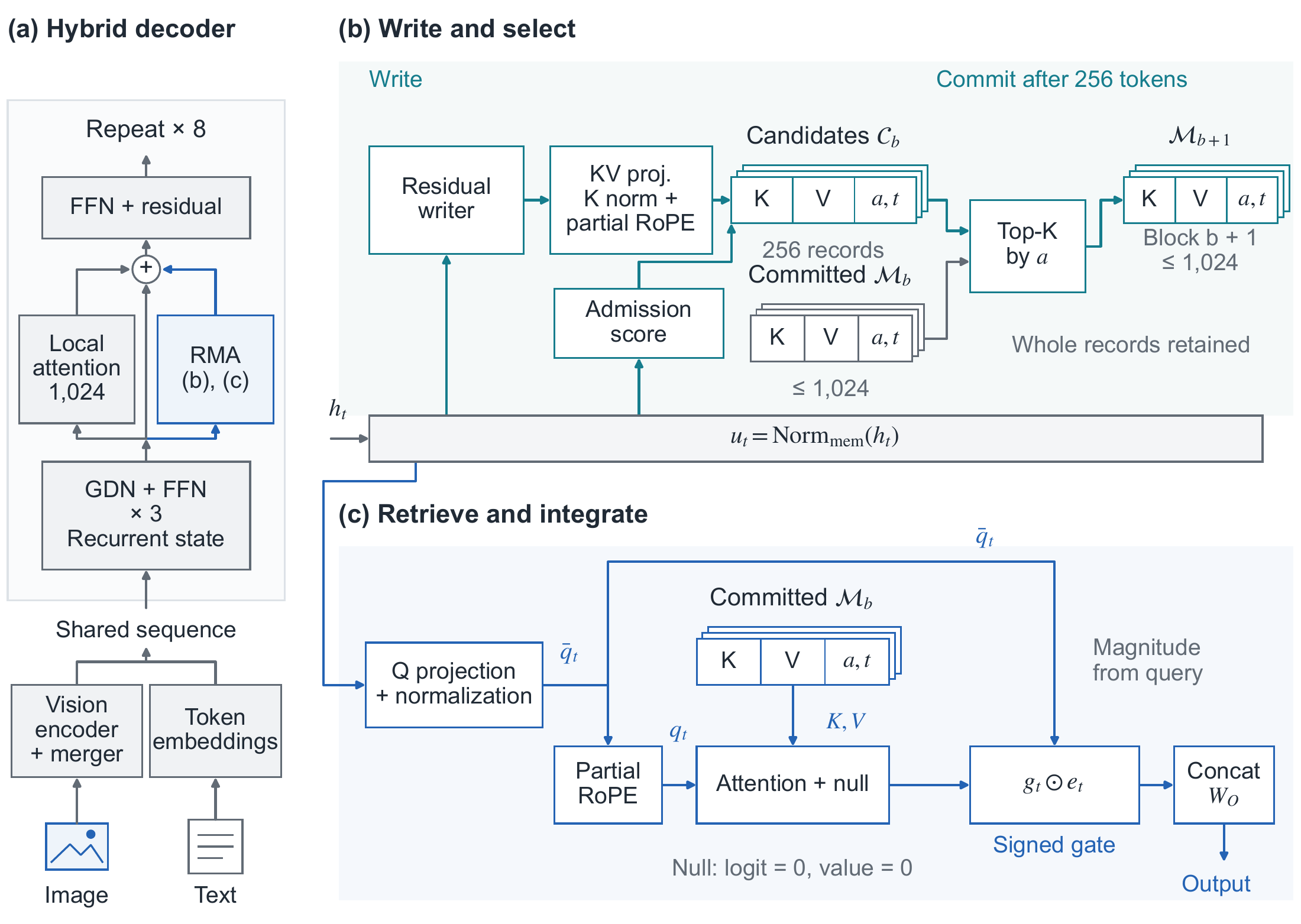
Three complementary components carry the history:
| Component | What it contributes | Capacity |
|---|---|---|
| Recurrent state | A continuously updated summary of the sequence | Fixed-dimensional state |
| Local attention | Direct interaction with recent tokens | 1,024-token window |
| Rock Memory Anchors | Direct retrieval of selected distant information | 1,024 records per KV group |
The writer creates candidate records, admission selects which records remain, and retrieval determines how memory contributes to the current computation. Every 256 tokens, candidates compete with existing anchors for space in the bank. Queries read the committed bank; the selected update becomes available in the next block.
Fixed capacities give O(1) persistent history as sequence length grows. EdgeRock-4B achieves 94.1% accuracy across 1,024 distant-memory queries covering exact retrieval, state updates, cross-document combination and variable binding.
For long-running agents, this makes history storage predictable across extended reasoning trajectories. For serving systems, it leaves more memory available for active requests. For memory-constrained devices, it provides a fixed history budget that can be planned alongside perception and other workloads.
Run EdgeRock with Ollama
Runtime: Linux x86-64 · NVIDIA Hopper · EdgeRock RMA-enabled Ollama. Stock Ollama does not yet implement RMA; use the supplied runtime for the commands below.
1. Get the runtime
Download the runtime archive from the GGUF repository, then extract it:
hf download hkust-aaron/EdgeRock-4B-GGUF \
  edgerock-native-linux-sm90.tar.gz --local-dir EdgeRock
cd EdgeRock
tar -xzf edgerock-native-linux-sm90.tar.gz
2. Start the server
export EDGEROCK_NATIVE="$PWD/edgerock-native-linux-sm90"
export LD_LIBRARY_PATH="$EDGEROCK_NATIVE/lib/ollama:${LD_LIBRARY_PATH:-}"
export OLLAMA_HOST=127.0.0.1:11435
export OLLAMA_MODELS="$PWD/ollama-models"
export OLLAMA_NUM_PARALLEL=1
export OLLAMA_MAX_LOADED_MODELS=1
export XDG_CONFIG_HOME="$PWD/ollama-config"
"$EDGEROCK_NATIVE/bin/ollama" serve
3. Pull and chat
In a second terminal, use the same working directory and environment exports, then run:
"$EDGEROCK_NATIVE/bin/ollama" run rockmatrix-ai/edgerock:4b-q4_k_m
The model is downloaded from this Ollama repository on first use.
| Ollama tag | Quantization | Weight size |
|---|---|---|
4b-q3_k_m |
Q3_K_M | 2.44 GB |
4b-q4_0 |
Q4_0 | 2.77 GB |
4b-q4_k_s |
Q4_K_S | 2.79 GB |
4b-q4_k_m |
Q4_K_M · default | 2.94 GB |
4b-q5_k_m |
Q5_K_M | 3.35 GB |
4b-q6_k |
Q6_K | 3.79 GB |
4b-q8_0 |
Q8_0 | 4.89 GB |
4b / latest |
Aliases of 4b-q4_k_m |
Same weights |
The default context allocation is 16,384 tokens and the default generation limit is 1,024 tokens. All seven profiles are also available in the GGUF collection, each with its matching Modelfile. To select a different quantization in Ollama, replace the tag in the command above.
Package validation
The Q4_K_M package passed 4⁄4 functional checks in the custom Ollama runtime: arithmetic, two long-memory tasks with 9,664 and 10,462 input tokens, and state reset between requests. Validation receipts and weight hashes accompany the release.
Explore EdgeRock
The original model supports text and image reasoning. This Ollama package serves text; the original multimodal weights, inference code and further deployment formats are available below.
| Resource | Contents |
|---|---|
| GitHub | Architecture, inference code, evaluation results and deployment guides |
| Technical Report | Method, capability benchmarks and system measurements |
| Original Model | Original EdgeRock-4B weights and model documentation |
| GGUF Collection | Seven quantization profiles, custom Ollama and llama.cpp backends |
| Model Directory | MLX, ONNX, compact PyTorch and LiteRT-LM packages |
License
Model weights use the EdgeRock Model License 1.0, included in this model’s license layer. Runtime code uses Apache-2.0, with upstream notices retained.
ROCK MATRIX · Strong Reasoning at Constant Memory